Karl Graf Stauffenberg spoke at the invitation of FDP state parliament candidate Claudia Felden
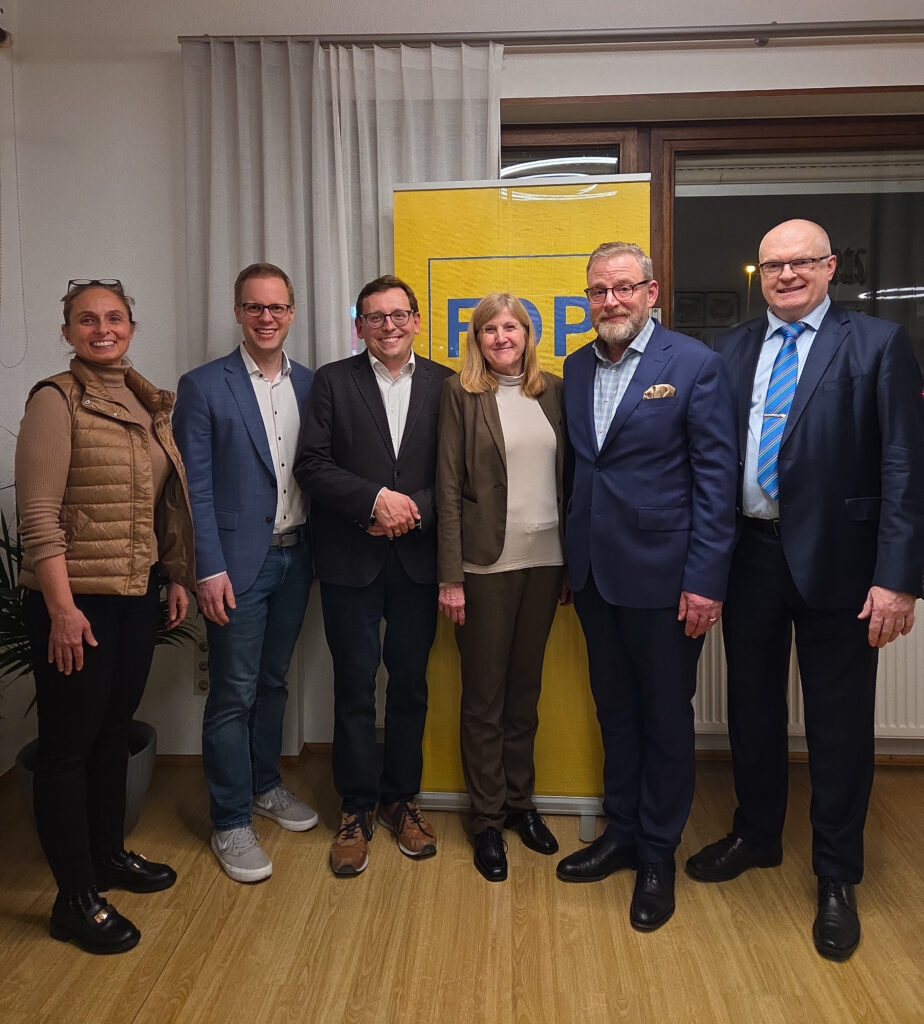
Leimen. Some time before the event began, there were no free chairs left and more had to be brought in hastily. That is how great the turnout was when FDP state parliament candidate Claudia Felden, together with the FDP local branch Leimen, recently hosted a political lecture evening at the La Vite restaurant in Leimen. The guest speaker was Karl Graf Stauffenberg, the grandson of Claus Schenk Graf von Stauffenberg (on 20 July 1944, Claus Schenk Graf von Stauffenberg carried out the ultimately unsuccessful assassination attempt on Adolf Hitler). Karl Graf Stauffenberg spoke about the current state of democracy.
In his words of welcome, FDP local branch chair Alexander Hahn explained the historical significance of 20 July 1944 and the role of Claus Schenk Graf von Stauffenberg. He emphasised that democracy cannot be taken for granted, but rather that every generation has to defend it anew.
Claudia Felden, FDP state parliament candidate, picked up on this in her address. She stressed that freedom, the rule of law and economic strength are key prerequisites for a stable democracy. Especially in times of uncertainty and social tension, she said, we need citizens who take responsibility and actively get involved. Politics thrives on the commitment of people on the ground and on open dialogue.
The focus of the evening was then the lecture by Karl Graf
Stauffenberg. Under the guiding theme “How do we save democracy –
and what is the state of our country?”, he drew a line from historical experience to today’s challenges.
Stauffenberg described how many people are currently shaped by worries: economic uncertainty, a lack of economic growth, rising costs and also the fear of war and of possible energy shortages. According to Stauffenberg, such fears can strain trust in politics and the state. Similar fears had already existed in the ultimately failed Weimar Republic, when economic crises and anxiety about the future unsettled large parts of society.
Stauffenberg also looked at political structures: in the Weimar Republic, governing coalitions often consisted of parties with strong programmatic differences. For this reason, the Reich governments of the time were frequently unstable.
Stauffenberg saw parallels here with today’s political developments: recent times, too, have shown how difficult it is when coalition partners remain permanently at odds on fundamental questions. Political stability, however, is crucial for trust in democracy.
He also addressed major crises that shape societies: alongside the consequences of the First World War, the Spanish flu, a worldwide pandemic from 1918 to 1920, had an enormous impact on people in the Weimar Republic. He linked this to the coronavirus pandemic. According to Stauffenberg, it is important not only to get through crises, but also to come to terms with them and draw lessons for the future.
Stauffenberg placed particular emphasis on the personal responsibility of each individual. He deliberately chose not to use the term “hero” for his grandfather, Claus Schenk Graf von Stauffenberg. A hero, Stauffenberg explained, often appears to be an unattainable figure from afar – someone with whom the “ordinary person” cannot compare themselves. That is exactly what Stauffenberg wants to avoid. For him, his grandfather is rather an example of the fact that every person can take responsibility and find the courage to stand up for their convictions. For Stauffenberg, civil courage is not a question of special origins or extraordinary abilities, but a decision that, in principle, anyone can make.
This message ran like a common thread through the evening: democracy depends on people not looking away, but getting involved. Freedom and the rule of law are the result of the efforts of many – then as now.
The subsequent discussion developed into a lively exchange on trust in politics, economic prospects and social cohesion. The evening made clear how much the question of the future of democracy moves many people – and that its strength ultimately depends on the commitment of each individual. In closing, Hahn thanked Graf Stauffenberg for his extremely rewarding lecture and Claudia Felden for having brought Graf Stauffenberg to Leimen as a speaker through her extensive network.